
Hydrogen Infrastructure Boost: Rolls-Royce Launches Modular Hydrogen-Ready Power Plants
February 17, 2026Executive Summary
Back in February 2026, Rolls-Royce Power Systems pulled back the curtain on its new modular, hydrogen-ready gas engine power plants, tailor-made for Germany’s Power Plant Strategy. The solution comes in preconfigured Modular Gas Engine Power Plants (MEPP) blocks of 10, 20 or 30 megawatts, ready to plug into the grid within 12–18 months of ordering. You can deploy them one by one or cluster them together, scaling from a few megawatts up to hundreds, depending on what you need. Riding on a global footprint of about 17 gigawatts and nearly 500 MT generators helping stabilize the UK grid, Rolls-Royce is pitching MEPP as a fast, flexible answer to Germany’s ongoing Energiewende—a real pulse check for sustainable energy. The concept got its spotlight at the E-world energy trade fair in Essen and sparked interest from utilities and big industrial players. It’s a compelling pitch that could steer further investment into gas-powered backup and future-proof hydrogen infrastructure.
Historical Context
Germany’s journey toward decarbonized power took a sharp turn after the 2011 Fukushima crisis, when the government vowed to phase out nuclear and curb coal use as part of its Energiewende. Over the next decade, wind and solar shot past 50% of installed capacity, but that boom also meant wild swings in supply and sharper balancing costs. Meanwhile, across the Channel, the UK’s 2014 capacity market rewarded fast-start assets capable of peaking exactly when needed—leading to nearly 500 MT gensets from Rolls-Royce Power Systems stepping up. Those lessons in decentralization, quick ramp-up and grid stability, backed by detailed market analysis from the UK capacity auctions, laid the groundwork for the MEPP design, now tuned to Germany’s stricter emissions rules and rising carbon pricing.
Strategic Impact
MEPP checks off several strategic boxes for Germany’s energy ecosystem:
- Speed to Market: Factory validation and preassembly slash site work, targeting 12–18 months versus more than five years for traditional plants.
- Operational Agility: Standalone 10, 20 or 30 MW modules can start, stop or ramp independently, matching demand and shoring up frequency, spinning reserve and other grid services.
- Hydrogen Infrastructure: Engines are built to run on blends up to 100% hydrogen down the line, future-proofing for the hydrogen economy.
- Decentralized Resilience: Distributed modules cut single-point failure risk, boosting grid reliability and cyber resilience.
- Ancillary Revenue: Smart controls allow participation in black start, voltage support and stabilization programs, opening new income streams.
- Local Investment: Working with prequalified EPC partners speeds permits, creates jobs and keeps economic benefits in regional communities.
- Policy Alignment: Directly supports Germany’s capacity margin goals and low-carbon transition targets under the Power Plant Strategy.
Technical Snapshot
Here’s the breakdown of the Modular Gas Engine Power Plants (MEPP):
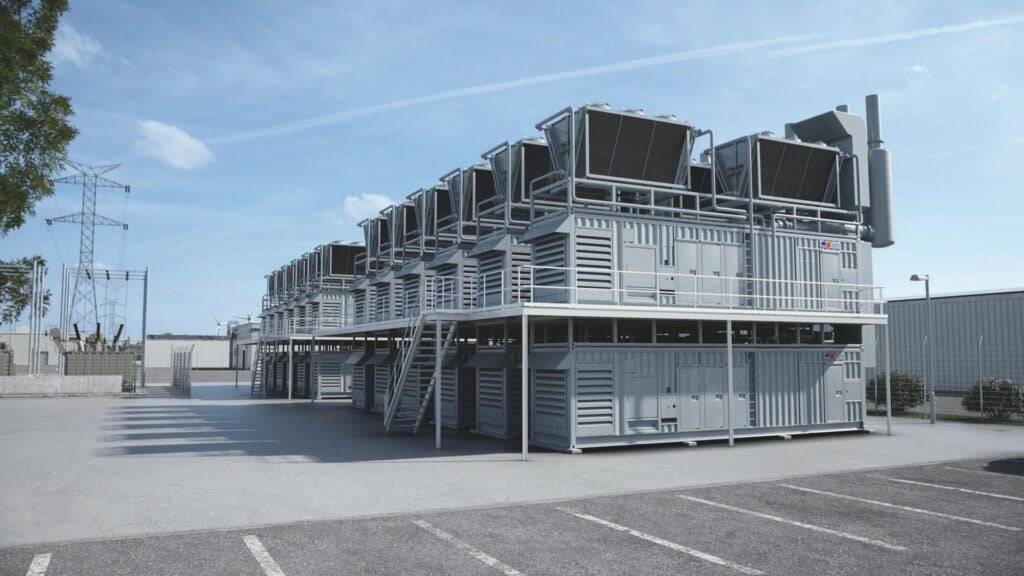
- MT gas engine sets: Rated at 10, 20 or 30 MW and adapted from proven marine and industrial platforms for robust performance.
- Integrated power electronics: Switchgear and transformers come prewired to simplify grid tie-in and minimize on-site wiring.
- Digital Twin Automation: Central control units with digital twin capabilities for remote monitoring, predictive maintenance and real-time analytics.
- Optional retrofit modules: The mtu KineticPack flywheel UPS for instant backup, mtu Energy QX lithium-ion batteries for short-duration storage, and modular carbon capture skids to remove CO₂.
- Containerized skid design: Standardized civil works and logistics streamline transport and installation, cutting project risk.
Every module is factory tested for full-load performance, emissions compliance and software integration, so on-site commissioning takes weeks, not months.
Implementation & Partners
MEPP modules are built and validated at Rolls-Royce’s European sites, then shipped ready to slot in at customer locations. A network of German EPC partners handles everything from groundwork to grid connections and permits. Once live, regional service centers offer 24/7 remote diagnostics, digital maintenance alerts and scheduled overhauls. As Tobias Ostermaier, President of Stationary Power Solutions, notes: “Tapping local expertise speeds approvals and embeds economic value right in the community.” Michael Stipa, Senior VP for Strategy, adds that the redeployable design gives asset owners the flexibility to reconfigure capacity without writing off major capital—a smart move for industrial decarbonization and long-term investment planning.
Opportunities & Considerations
MEPP brings a lot to the table, but stakeholders should weigh these factors:
- Energy Security: Quick capacity boosts reduce import reliance and smooth out price swings.
- CAPEX Protection: Hydrogen-ready specs ensure capital aligns with future decarbonization pathways.
- Environmental Trade-offs: Natural gas combustion is still fossil-based; carbon capture helps, but depends on storage infrastructure.
- Market Competition: Gas-based capacity may vie with battery storage and utility-scale renewables for funding.
- Fuel Transition Timing: Green hydrogen availability and cost parity are evolving, which may affect conversion schedules.
- Revenue Fragmentation: Serving multiple grid services demands sophisticated operations and may complicate income streams.
Key Takeaways
- Fast Grid Connection: 12–18 month delivery cycle versus more than five years for conventional plants.
- Modular Scalability: Systems flex from under 10 MW to several hundred megawatts.
- Proven Pedigree: 17 GW installed globally with 500 MT gensets stabilizing the UK grid.
- Hydrogen-Ready: Engine architecture set up for future H₂ blends.
- High Efficiency: Up to 80% total efficiency in combined heat and power configurations.
- Resilient Design: Decentralized modules reduce reliance on a single plant or transmission corridor.
- Sustainable Energy Impact: Supports Germany’s drive toward a low-carbon, sustainable energy future.
Outlook
With Germany set to retire its last coal-fired plants and ramp renewables past 65%, the demand for dispatchable backup is only going up. Beyond big utilities, major energy consumers—from data centers and chemical facilities to district heating networks—are eyeing on-site modular solutions to lock in supply and hedge against price volatility. As carbon pricing climbs, the predictable lead times and hydrogen-readiness of MEPP modules could make them a go-to in long-term power procurement strategies.
Looking beyond Germany, markets where grid upgrades and licensing timelines lag—like Italy and Spain—stand to benefit too. By combining rapid capacity deployment with a clear pathway to hydrogen infrastructure, Rolls-Royce Power Systems’ MEPP line offers a practical bridge between today’s energy security challenges and tomorrow’s low-carbon ambitions—supported by thorough market analysis, driving industrial decarbonization and attracting smart investment.

 With over 15 years of reporting hydrogen news, we are your premier source for the latest updates and insights in hydrogen and renewable energy.