
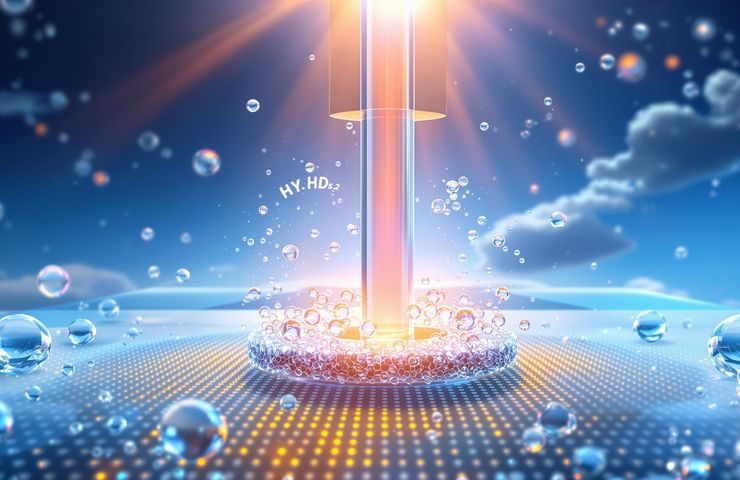
Hydrogen Production Device Achieves 28% Solar-to-Hydrogen Efficiency with Waste Heat
February 13, 2026Innovation at a Glance
Here’s the scoop: a team from National Taiwan University and National Tsing Hua University has whipped up a small, mighty gadget that turns sunlight and waste heat into hydrogen with a record 28% solar-to-hydrogen efficiency. The study dropped in Advanced Energy Materials on February 10, 2026 (DOI: 10.1002/aenm.202505382) and is led by Bishal Kumar Nahak, with Zong-Hong Lin as co-corresponding author. Their secret sauce? Marrying a Ti₃C₂-CdS heterostructure photoelectrocatalyst with a thermoelectric-assisted cascaded microreactor. As Lin quips, “This tech lets us tap both sunlight and waste heat to generate clean hydrogen.” It’s a savvy twist on hydrogen production, and a major leap forward for fuel cell technology.
Why Hydrogen Matters
You might be wondering, why all the fuss over hydrogen? Well, it’s more than just a fuel—it’s an energy carrier that, when you pop it into a fuel cell or blast it in combustion, leaves nothing behind but water. That zero-emission magic is exactly why green hydrogen is stealing the spotlight in the quest for industrial decarbonization and sustainable energy. Governments and industries eyeing net-zero targets see hydrogen as a key player in heavy-duty transport, steelmaking and grid balancing. Yet today, most green hydrogen comes from pricey electrolysis powered by renewables. By tapping both sunlight and abundant industrial waste heat, this new gadget could slash costs and spark decentralized hydrogen production right where it’s needed.
Technical Dive: Catalyst and Microreactor
Let’s roll up our sleeves and look under the hood:
- Ti₃C₂-CdS heterostructure catalyst: Think of this 2D nanomaterial as a tag team—cadmium sulfide soaks up sunlight and kicks off electron-hole pairs, while titanium carbide amps up conductivity and keeps those charges from cancelling out.
- Microfluidic reactor design: Tiny channels speed up mass transfer, guarantee even light exposure and lock in optimal temperature control. The cascaded layout sets up sequential reaction zones, squeezing more throughput into a small footprint.
- Thermoelectric integration: Instead of letting waste heat drift away, thermoelectric modules snatch it up, turn it into electricity and feed it back to supercharge hydrogen evolution—pushing overall solar-to-hydrogen efficiency to 28%.
In action, you pump water through microchannels under sunlight; the catalyst splits H₂O, releasing hydrogen, then the thermoelectric bits harvest leftover warmth to keep the reaction humming. It’s a neat energy-recycling loop that maximizes output while minimizing waste—ideal for cutting-edge fuel cell technology and distributed hydrogen production.
Historical Context of Solar Hydrogen
Believe it or not, solar-driven hydrogen research kicked off in the 1970s with photocatalysts barely cracking 1–2% efficiency. Over the decades, teams worldwide chased double-digit goals. The US Department of Energy even set its sights on >10% solar-to-hydrogen by 2025, and renewable hubs in Australia are breaking ground on pilot plants to scale lab victories. Still, commercial rollouts lagged due to low efficiencies and hefty price tags. That’s why hitting 28% in an integrated device is huge—it triples many early targets and paves the way for real-world demos, fast-tracking sustainable energy solutions.
Business and Strategic Implications
For industry players, this could shake up the green hydrogen market:
- Cost savings: Microreactors need far less catalyst and infrastructure than massive electrolyzers, trimming capital expenses.
- Decentralized deployment: Small modules can sit right next to waste heat sources—think factories, data centers or waste-to-energy plants—slashing transport and storage headaches.
- Market differentiation: Companies offering integrated solar-heat solutions can stand out in Europe, Asia and beyond, tapping booming demand for zero-emission tech.
With policy incentives favoring low-carbon solutions, the timing couldn’t be better. NTU and NTHU are already in talks with industrial firms and energy startups about pilot runs. If the numbers hold up, commercial units could roll out in 2–3 years, fueling a new wave of industrial decarbonization and sustainable energy deployment.
Environmental and Collateral Benefits
Beyond hydrogen, this device packs extra perks:
- Water purification: The same reactions that split water also break down organic contaminants, a bonus for regions lacking clean water.
- Reduced carbon footprint: By reusing waste heat instead of drawing extra power, you cut CO₂ emissions even further.
- Scalable modules: Reactors can be stacked like building blocks to boost output without a major redesign.
Picture a remote off-grid hamlet running a containerized unit that supplies hydrogen for cooking or generators while pumping out drinkable water—all powered by sunshine and leftover heat from a biomass plant. That’s the kind of win-win we need for sustainable energy and local resilience.
Challenges and Future Outlook
Of course, there are bumps in the road:
- Material scaling: Cranking out consistent, high-quality Ti₃C₂ at industrial scale remains a lab-level puzzle.
- Durability: Day–night cycles, temperature swings and real-world conditions demand long-term stability tests.
- Integration costs: Fitting thermoelectric modules into compact reactors adds complexity and upfront spend.
To tackle these, NTU and NTHU teams have kicked off extended field trials and teamed up with industry partners to refine manufacturing and cut unit costs. What’s next? Keep an eye out for endurance data from pilot sites, detailed cost breakdowns for scaled production and supportive policy frameworks for combined solar and heat-to-hydrogen tech.
As the race to decarbonize heats up, efficient, modular hydrogen production could give green hydrogen and fuel cell technology the boost they need. We might soon spot solar-heat hydrogen stations popping up in industrial parks and rural hubs alike—for a real leap toward sustainable energy.
source: wiley.com

 With over 15 years of reporting hydrogen news, we are your premier source for the latest updates and insights in hydrogen and renewable energy.