Kolon Industries and Ballard Power Systems Sign MOU on Hydrogen Fuel Cells Collaboration
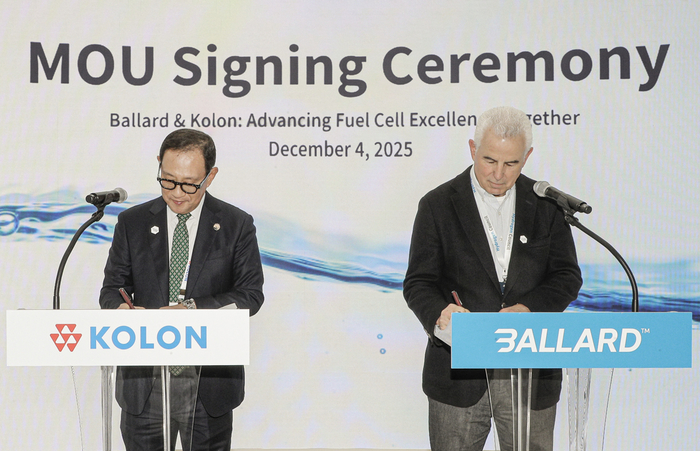
December 8, 2025In December 4, 2025, over at the Korea International Exhibition Center (KINTEX) in Ilsan, Kolon Industries and Ballard Power Systems have shook hands on a Memorandum of Understanding. Essentially, Kolon’s knack for advanced materials and specialty chemicals is teaming up with Ballard’s global rep for hydrogen fuel cells. With South Korea’s big plans for green hydrogen and a robust hydrogen infrastructure push in the background, this MOU lays out shared R&D on membrane electrode assemblies (MEAs), pilot lines for fuel cell stacks, and co-funded demo units for buses, trucks, and stationary power. Neither side’s spilling the exact dollar figures yet, but they’re both eyeing national grants to help push scaling and commercialization forward.
Core Announcement
The ceremony in Ilsan—an industrial and technology hub—was more than just a photo op; it kicked off what’s shaping up to be a multi-year collaboration. Under this MOU, Kolon and Ballard plan to stand up a joint research lab by Q1 2026. They’ll dive into everything from polymer electrolyte membranes and catalyst layer optimization to full balance-of-plant integration. The aim is to have prototype fuel cell stacks validated by mid-2026, and then roll out field trials on South Korea’s city bus routes late that year. They’re also eyeing digital diagnostics, remote stack monitoring, and localizing their supply chain for the key components.
Technical Focus: PEM Fuel Cells
Let’s break down where the tech shines: it’s all about Proton Exchange Membrane or PEM fuel cells. They’re prized for packing a punch in a small footprint and firing up on the spot. Here’s the simple version: hydrogen flows over the anode, a platinum catalyst splits it into electrons and protons. The electrons rush through an external circuit (hello, usable power!), while the protons slip through the membrane and reunite with oxygen at the cathode, giving off nothing but water. Kolon’s planning to weave its specialty fibers into next-gen gas diffusion layers to nail down water management and boost thermal conductivity—think trimming stack weight by around 10% and cutting platinum loading by 20%, without missing a beat. On the flip side, Ballard’s Balance-of-Plant expertise—compressors, humidifiers, digital controllers—fills in the gaps, aiming for modular, scalable systems that can slide right into existing vehicle platforms. Oh, and they’re not stopping there: hybrid setups mixing hydrogen fuel cells with lithium-ion batteries are on the table for tackling peak power demands.
Regional Catalyst in South Korea
Putting these pilot projects in Ilsan wasn’t an accident. Nestled in Gyeonggi Province, just outside Seoul, the area has evolved from a sleepy ’90s satellite town to a cleantech R&D hotspot. Under South Korea’s hydrogen economy roadmap, the country’s shooting for 15 GW of fuel cell capacity and 6.2 million fuel cell vehicles by 2042. Add in over 40 refueling stations today (with 20 more on the way) and you’ve got a thriving hydrogen infrastructure. Toss in some sweet tax breaks and strong ties with Seoul National University’s hydrogen labs, and Kolon and Ballard get a head start—no wasted time moving from prototypes to public roads.
Market Context and Synergies
If you zoom out, the global market for green hydrogen and hydrogen production tech is set to top $200 billion by 2030, thanks to tougher decarbonization goals and carbon pricing. In the Asia-Pacific playbook, South Korea’s already a poster child, with subsidies for fuel cell rollouts and penalties for dirty power. Fleet operators crunching the numbers are seeing that hydrogen fuel cells now stack up better than diesel for medium- and heavy-duty vehicles, especially as electrolyzer costs keep dropping. Kolon’s chops in advanced composites and chemical catalysts mesh neatly with Ballard’s push for sub-$100/kW systems. That combo could speed up local sourcing for MEAs, gas diffusion layers, and bipolar plates, cutting out import headaches and shielding them from wild swings in platinum and rare-metal prices. No wonder private equity players are circling—there’s talk of fresh investments or even joint ventures on the horizon.
Strategic Implications
So, what does this mean for each company? For Kolon Industries, it’s a savvy move into sustainable energy, branching out from its core in chemicals and fibers. They’re now positioned to ride the full hydrogen value chain, not just sell the raw materials. As for Ballard Power Systems—sitting on about $720 million in cash and pulling in $27.6 million in Q3 2024—they lock in a prime spot in a lightning-fast-growing market. Smaller stack makers might start sweating, eyeing mergers or partnerships just to keep pace. Plus, the deal underscores how government-backed incentives can really get the private sector marching in step. If these units prove rock-solid across ports, rail lines, and stationary power plants, it could set a blueprint for exporting hydrogen solutions worldwide.
A quick glance at the backstory: Ballard Power Systems kicked off in 1979 in Burnaby, British Columbia, started with lithium batteries, then made a hard pivot to fuel cells in 1983. Fast-forward, and their PEM modules power everything from buses and trucks to rail cars and marine vessels—racking up over 150 million kilometers by late 2024. Kolon Industries, on the other hand, began life in 1959 as a textile outfit. Since then, it’s branched into chemicals, specialty fibers, and high-tech materials. While Kolon has dipped its toes into hydrogen—think membrane research and small-scale academic tie-ups—this MOU is the first time they’re jumping in with both feet.
Looking ahead, Kolon and Ballard are eyeing a joint R&D facility near Ilsan by Q1 2026, followed by pilot stack production around mid-2026. By late 2026, bus trials in Seoul should yield hard data on performance, durability, and total cost of ownership. Everything’s synced up with South Korea’s national hydrogen targets, with an eye on commercial-scale manufacturing by 2028. Nail it, and they’ll be front and center as Asia’s go-to hydrogen infrastructure supplier, offering a partnership model other regions can copy. We’ll definitely be watching as they chart a path toward industrial decarbonization and zero-emission transportation.


 With over 15 years of reporting hydrogen news, we are your premier source for the latest updates and insights in hydrogen and renewable energy.